


Dealing with the IRS can be overwhelming—especially when they are making collection moves like placing liens or levying bank accounts. If you’re facing delinquent tax debt, know this: you do have options.
What is an IRS Lien?
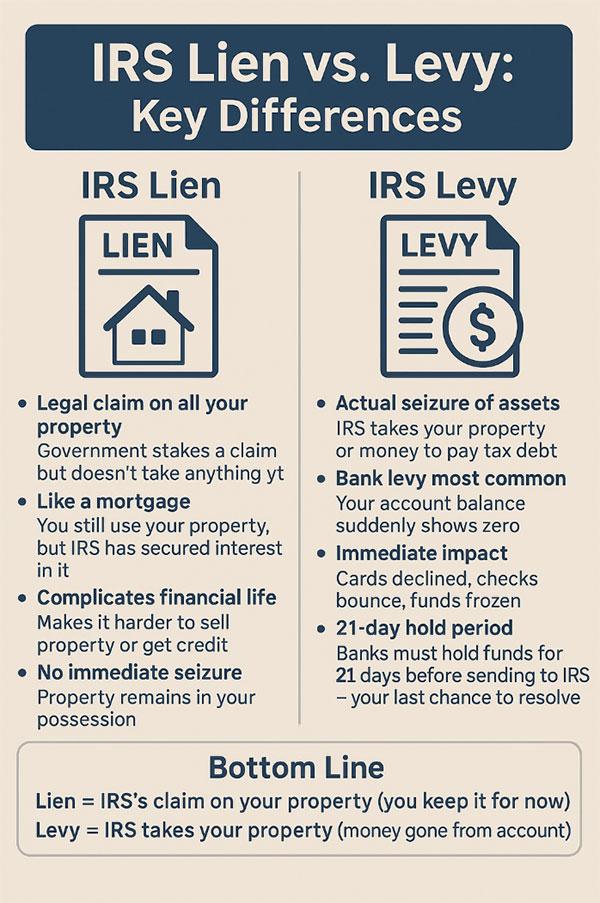
An IRS lien is essentially the government planting a flag on everything you own, saying “we have a legal claim to this until you pay your tax debt.”
It’s important to understand that a lien doesn’t mean they’re taking your property right now—think of it more like a mortgage company having an interest in your house.
The property is still yours to use, but the IRS has secured their interest in it.
What is an IRS Levy?
Unlike a lien, which is more of a legal technicality that complicates your financial life, a levy involves the IRS actually seizing your assets to satisfy your tax debt.
The most common type of levy is a bank levy. Here’s how it typically plays out: You wake up one morning, check your bank account to make sure your direct deposit hit, and find your balance is zero.
Or worse, you’re at the grocery store, your card gets declined, and you discover the IRS has frozen your account.
When the IRS levies your bank account, the bank is required to hold the funds for 21 days before sending them to the IRS. This 21-day window is your last chance to resolve the issue before the money is gone for good.
Other Tools: The IRS’s Expanding Collection Powers
Beyond liens and levies, the IRS has been granted additional collection tools over the years that can impact your daily life in ways you might not expect.
These newer enforcement mechanisms show just how serious the government is about collecting tax debts.
Passport Revocation is one of the more dramatic tools in the IRS’s arsenal. If you owe more than $62,000 in tax debt (this threshold adjusts annually for inflation), the IRS can certify your debt to the State Department, which can then revoke your existing passport or refuse to issue or renew one.
Imagine planning an international business trip or family vacation, only to find out at the airport that your passport has been revoked.
For people who travel internationally for work, this can be career-ending. The only way to get your passport back is to pay the debt in full, set up an installment agreement, or otherwise resolve your tax situation.
Driver’s License Suspension isn’t directly done by the IRS, but many states have programs where they’ll suspend your driver’s license if you have significant unpaid state taxes.
Some states are also starting to share information with the IRS about federal tax debts.
Losing your ability to drive legally can make it impossible to get to work, which creates a vicious cycle—you need to work to pay your tax debt, but you can’t get to work without a license.
Trust Fund Recovery Penalty (TFRP) assessments are particularly nasty surprises for business owners and anyone considered a “responsible person” in a business.
If a business fails to pay its payroll taxes (the taxes withheld from employees’ paychecks), the IRS can assess the Trust Fund Recovery Penalty against individuals personally.
This means if you’re a business owner, CFO, or even sometimes a bookkeeper with check-signing authority, you could be held personally liable for the business’s unpaid payroll taxes.
Professional License Suspension is another tool some states use, where they’ll suspend professional licenses (medical, legal, contractor, real estate, etc.) for unpaid taxes.
While this is typically a state-level action for state taxes, some states are beginning to coordinate with federal tax authorities.
Seizure of Government Payments and Benefits extends beyond just Social Security. The IRS can intercept federal vendor payments if you do business with the government, federal employee retirement benefits, and even some federal grants.
During tax season, they automatically grab any federal tax refunds you might be owed and apply them to your old debt—a process called a refund offset.
Public Shaming and Business Consequences might not be official IRS tools, but they’re real consequences of collection actions.
In some jurisdictions, lists of delinquent taxpayers are published online.
Business credit reports often show tax liens and levies, making it difficult to get trade credit or favorable payment terms from suppliers.
Some professional organizations and licensing boards consider tax problems when evaluating members or renewal applications.
The IRS does typically offer payment plans, hardship programs, and other alternatives that can help you avoid these harsh collection actions.
These actions are serious. They can damage credit, cost you money in fees, and in worst cases, take property you value. The IRS doesn’t always get it right, which is why it’s worth reviewing the accuracy of what’s owed.
Key Options to Resolve Collection Issues
Finding yourself on the wrong side of IRS collections can feel overwhelming, but here’s something that might surprise you: the IRS actually wants to work with you.
They’d much rather have a cooperative taxpayer making payments than spend resources on aggressive collection actions.
That’s why they’ve created multiple programs and options to help people resolve their tax debts. The trick is knowing which option fits your situation and how to navigate the application process successfully.
Let’s explore each of these resolution options in detail, so you can understand not just what they are, but when they make sense, how to qualify, and what to expect if you pursue them.
Installment Agreements
An installment agreement is essentially a payment plan with the IRS, and it’s by far the most common way people resolve tax debts.
Think of it like financing a car, except instead of driving off the lot with a new vehicle, you’re buying yourself peace of mind and protection from aggressive collection actions.
For many taxpayers, this is the sweet spot between what they owe and what they can realistically afford to pay.
The beauty of an installment agreement is its simplicity and accessibility. If you owe less than $50,000 and can pay off the balance within 72 months, you can often set up a streamlined agreement online without even talking to anyone or providing financial documentation.
Offer in Compromise
An Offer in Compromise (OIC) is what everyone hopes for—the chance to settle your tax debt for less than the full amount owed.
It’s the IRS saying, “Okay, we’ll take what we can get rather than nothing at all.” But despite what those late-night TV commercials suggest, getting an OIC approved isn’t easy, and it’s definitely not available to everyone.
The IRS accepts offers in compromise for three reasons: doubt as to collectibility (you genuinely can’t pay the full amount), doubt as to liability (there’s a legitimate dispute about whether you actually owe the tax), or effective tax administration (paying the full amount would create an economic hardship or would be unfair and inequitable).
Penalty Abatement
Penalties and interest can easily double or triple your original tax debt if left unchecked.
The good news is that unlike the underlying tax, penalties can sometimes be reduced or eliminated entirely through penalty abatement.
One strategic consideration: if you qualify for first-time abatement, think carefully about when to use it.
Since you can only use it once every three years, you might want to save it for the tax period with the highest penalties.
Also, if you’re negotiating an offer in compromise or installment agreement, you might want to wait until after that’s settled to request abatement, as the reduced balance could affect your negotiations.
Innocent Spouse Relief
The IRS doesn’t think you should be held responsible for your spouse’s tax crimes or omissions that you knew nothing about. Innocent spouse relief can release you from joint liability for taxes, penalties, and interest that should be solely your spouse’s responsibility.
It’s a recognition that sometimes one spouse controls the finances, hides income, or claims fraudulent deductions without the other’s knowledge.
There are actually three types of relief available: innocent spouse relief, separation of liability, and equitable relief.
Classic innocent spouse relief applies when your spouse (or ex-spouse) improperly reported or omitted items on your joint return without your knowledge.
Separation of liability allows you to allocate tax liability between you and your former spouse.
Equitable relief is the catch-all for situations that don’t fit the other categories but where it would be unfair to hold you liable.
The requirements for innocent spouse relief are strict. You must have filed a joint return with an understatement of tax due to erroneous items attributable to your spouse.
You must establish that you didn’t know and had no reason to know about the understatement. And it must be unfair to hold you liable considering all facts and circumstances.
Timing is critical for innocent spouse relief. Generally, you must request relief within two years after the IRS first attempts to collect the tax from you.
However, equitable relief has a longer timeline—you can request it within the period the IRS can collect the tax (generally 10 years from assessment) or within two years after payment if you’re seeking refund of taxes paid.
Discharge Through Bankruptcy
For income tax debt to be dischargeable in Chapter 7 bankruptcy, it must meet five criteria:
- the tax debt must be at least three years old (from the due date of the return)
- the return must have been filed at least two years ago
- the tax must have been assessed at least 240 days ago
- the return must not be fraudulent
- you must not have committed tax evasion.
Chapter 13 bankruptcy offers different advantages for tax debt. While it doesn’t eliminate tax debt as readily as Chapter 7, it can provide a structured 3-5 year payment plan that might be more favorable than what the IRS would offer directly.
Priority tax debts (recent income taxes, employment taxes) must be paid in full through the plan, but without additional penalties and sometimes with reduced interest. Non-priority tax debts might be paid at pennies on the dollar or discharged entirely.
What makes bankruptcy complicated for tax debts is the classification system.
Tax debts are categorized as secured (if there’s a filed tax lien), priority unsecured (recent taxes, trust fund taxes), or general unsecured (older taxes meeting discharge criteria).
One strategic consideration often overlooked: the timing of bankruptcy filing can dramatically affect which tax debts are dischargeable.
Filing a few months too early might mean a significant tax debt doesn’t meet the age requirements. Conversely, waiting too long might allow the IRS to file a lien, converting unsecured debt to secured debt that must be addressed differently in bankruptcy.
Release of Liens & Levies
Once you’ve resolved your tax debt or made arrangements with the IRS, getting liens and levies released should be a priority.
For levies, release can happen relatively quickly once you’ve addressed the underlying issue. If you’ve set up an installment agreement, proven financial hardship, or paid the debt, the IRS will typically release a levy within days.
Wage levies stop with the next payroll cycle after release. Bank levies are released before the 21-day holding period expires if you act quickly.
Liens are more complicated. By law, the IRS must release a lien within 30 days after the tax debt is fully satisfied. But “release” doesn’t mean the lien disappears from public records—it just shows as released.
For many taxpayers, particularly those trying to rebuild credit or refinance property, a lien withdrawal is preferable. This actually removes the lien from public records as if it never existed.
Understanding these resolution options is empowering, but choosing the right one—or combination—requires careful analysis of your specific situation.
Why Legal Representation Helps
Here’s why having an experienced advocate can be one of the best investments you make during a tax crisis.
Accuracy
A skilled tax lawyer knows how to scrutinize every line of an IRS assessment with a detective’s eye.
They understand the complex interplay between different sections of the tax code and can spot when the IRS has misapplied the law to your situation.
Experience with Negotiation
The IRS operates according to strict procedures, formulas, and guidelines that aren’t always intuitive or publicly well-documented.
Knowing these internal procedures—and more importantly, knowing how to work within them to your advantage—can make an enormous difference in the outcome.
Avoiding Worst Outcomes
One of the most valuable things a tax lawyer brings is the ability to prevent bad situations from becoming catastrophic.
They understand the IRS collection process and know exactly what triggers escalation from one enforcement level to the next.
More importantly, they know how to intervene at critical moments to prevent irreversible consequences.
Protecting Rights
A tax attorney serves as your advocate, ensuring the IRS follows proper procedures and respects your rights throughout the collection process.
They know when the IRS is overstepping its bounds and how to push back effectively.
What To Do If You’re Facing Collection Action
When facing IRS collection actions, every day matters.
The IRS follows a predictable escalation pattern—from notices to liens to levies to asset seizure—and each step becomes progressively harder and more expensive to reverse.
The key to a favorable resolution is taking swift, strategic action before your options narrow and enforcement actions become irreversible.
The most critical steps you can take right now are simple but essential: Don’t ignore IRS notices—each one contains important deadlines and rights that expire if you miss them.
Gather all relevant documents including tax returns, financial records, and any correspondence with the IRS.
Most importantly, understand that you have options beyond just paying in full—from installment agreements and Offers in Compromise to penalty abatement and Currently Not Collectible status.
The right strategy depends entirely on your specific situation, and navigating these options while avoiding costly mistakes requires deep knowledge of IRS procedures and negotiation tactics.
Let Goldburd McCone Protect Your Rights and Resolve Your Tax Crisis
At Goldburd McCone, we’ve spent decades helping taxpayers escape the nightmare of IRS collections.
Our experienced tax attorneys know how to stop aggressive collection actions, identify errors in IRS assessments, and negotiate the best possible resolution for your unique situation.
We’ve successfully reduced tax debts by hundreds of thousands of dollars, removed penalties, released liens and levies, and helped countless clients get their lives back on track.